What Steve Baker’s keynote (and a lesson from my own past) reminded me about financial literacy and culture
At last Thursday’s Vistage DMV Regional Executive Summit, the opening keynote by Steve Baker, President of The Great Game of Business, landed on a leadership lesson that was both simple and deeply impacting:
Most employees don’t understand how the basic business equation works, and that ignorance can be incredibly expensive.
Steve’s talk, “The Great Game of Business: Rapid Financial Results and Lasting Cultural Change”, wasn’t about turning everyone into accountants. It was about helping people see the economic consequences of everyday decisions.
The 10× Reality Most Teams Don’t See
One principle in particular stuck with me:
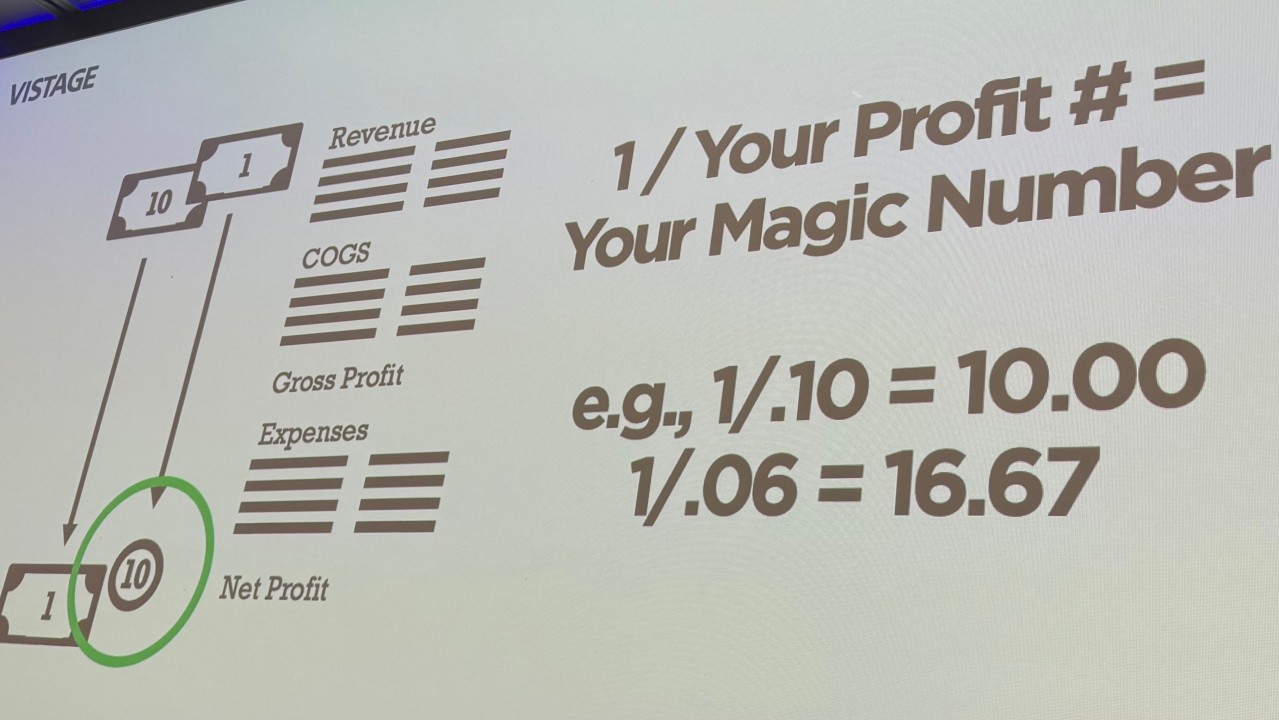
In the average businesses, it takes $10 of revenue to make up for $1 of operational inefficiency.
That’s not a finance abstraction. That’s daily behavior compounded over time.
Most leaders understand this intuitively, but most employees never get taught this explicitly. And that gap shows up everywhere.
The “Spoon Man” Story
Steve shared a story from a multi‑unit café chain that made the point unmistakable.
One employee – later nicknamed “the Spoon Man” – was responsible for smallwares, small dishes and utensils including spoons. Spoons were constantly disappearing and needing replacement. No malice. No carelessness. Just… no awareness as they got scraped off into the trash with leftover food.
Annual replacement cost? Not much per spoon, but they added up to roughly $20,000 per year.
At first glance, that sounds like noise – something you “sell more pancakes” to fix. But then Steve reframed it.
To generate $20,000 in profit, the company needed more than $200,000 in additional sales. That’s a lot of pancakes!
Same spoons. Completely different conversation.
Once the Spoon Man understood the math, he and his kitchen teams changed their behavior – dramatically. Not because of a new policy. Not because of fear. Because they now understood how their decisions connected to the scoreboard of the business.
I’ve Seen This Work from the Inside
As Steve was telling that story, I kept thinking about a very real example from my own past.
A good friend and colleague, Clayton Meeker, designed and taught an internal financial literacy program as part of Improving’s Employee Engagement Program (EEP). Rather than keeping financial understanding locked inside leadership meetings and the Accounting department, Clayton created a forum where employees learned good personal money management and how that translated to the business – revenue, margin, tradeoffs, and all.
These weren’t compliance trainings. They were invitations to learn – to feed employee curiosity and create a culture of continuous personal improvement. Employees shared insights. Leaders shared context. Curious questions were encouraged – not shut down. The goal wasn’t control; it was clarity and a culture of employee engagement.
And over time and across the whole EEP, something powerful happened.
- People made better decisions.
- Teams thought more holistically.
- Ownership showed up without being demanded.
That program didn’t just teach finance. It reinforced a culture of continuous learning and improvement that Improving was building and is still known for today.
Financial Literacy is a Cultural Tool
That’s what connected these two stories for me – Steve’s keynote and Clayton’s work at Improving.
Financial literacy isn’t about spreadsheets. It’s about trusting people with the truth.
The Great Game of Business philosophy rests on a powerful assumption:
If people understand how the business wins, they will engage and help it win.
Too many organizations:
- Share revenue targets at the top
- Discuss margin in closed rooms
- Measure outputs without explaining impact
So people optimize locally… and unintentionally destroy value globally. That’s not a motivation problem. It’s an education problem.
Where This Becomes a Leadership Opportunity
If culture really is “how we do things around here,” then financial literacy is culture. Not jargon. Not dashboards. But clear cause‑and‑effect thinking.
When leaders withhold the economics of the business – often out of habit or fear – they create systems where:
- Waste feels invisible
- Tradeoffs feel abstract
- Accountability feels arbitrary
And leadership ends up carrying weight the organization could be sharing.
A Better Question for Leaders
Both Steve’s keynote and my experience at Improving left me sitting with the same question:
Do the leaders and their teams that I work with know which “spoons” they’re holding?
Not metaphorically. Financially.
Because sometimes the fastest way to improve margins isn’t a new strategy or system – it’s a clearer explanation. And sometimes the most expensive thing in the room isn’t a bad decision. It’s an uneducated one.
This article was first published in my LinkedIn newsletter, Feeding the Flame. Read the original.