Author: tmgirvin

  • Innovating on Purpose

    Innovation is a change you choose. Lead it like one, and the same team delivers twice the impact.

    By Todd Girvin, founder of Futuremakers

    The 32-hour win nobody wanted to celebrate

    A CEO I coach told me a story a few weeks ago that I haven’t been able to put down.

    His marketing firm had just won a bid to analyze a client’s position in its market and build a strategy from what they found. The team scoped it at 120 hours. Even at that, they knew the honest truth about engagements like this one: you only get to look at a fraction of the competitive landscape, the market dynamics, and what the customer’s customer actually needs. You do your best inside the hours you sold.

    This time, one of his researchers used AI to help with the assessment.

    She didn’t hand the work to a machine. She steered it. She pointed it at hundreds of potential competitors instead of the twenty or thirty she would normally have had time for. She used what came back to identify the client’s real niche and true differentiators, then went deep on the handful of competitors who actually mattered. She shaped the findings into an approach for a strategic plan, polished it, and presented it.

    The client was elated.

    Total time: 32 hours.

    Here’s the part that matters most. The client could not have done this with AI on their own. They don’t have the market understanding or the expertise to steer the research to the right level and pull out what’s salient. Her judgment was the product. AI just gave her judgment more room, both breadth and depth, to work.

    The innovation brought more value for the client, more profit for the firm, and less effort for the researcher. By any scoreboard you’d care to pick, that’s a huge win.

    So why was the CEO worried about how it would be received?

    Because some of his people are already afraid of being replaced by AI. They resist the tools, especially for the creative work that they take pride in. Meanwhile, the colleagues who have embraced the tools are far more productive and far less stressed. The gap between the two groups was widening, and a 32-hour win was about to make it visible to everyone.

    That’s the moment I keep coming back to.

    It’s not the tool, not the hours – it’s the fear that a genuine win would land as a threat.

    I’ve heard versions of this story from several of the leaders I coach, in companies that make things, companies that serve people, and nonprofits that exist to change lives. The details change. The pattern doesn’t. The innovation works. But, the people aren’t sure they want it to.

    That CEO’s marketing firm is now doing what I’d recommend to anyone: taking a systematic look at its core processes, finding the biggest inefficiencies, and addressing them one at a time, with the team. AI happens to be the innovation on his desk this year. It won’t be the last. A new service line. A redesigned intake process. A merger. A program that finally reaches the people you’ve been missing. Innovation comes in many flavors, and every one of them lands on people the way the 32-hour win did. From that firm and others like it, I’ve pulled out an approach I call innovating on purpose, in both senses of the phrase. Chosen deliberately, because it serves the future your organization exists to create. And managed deliberately, as the intentional change it is, so every person on your team can see how it helps them do more of the work they already care about.

    The rest of this paper lays out that approach. But first, a word about what happens when the purpose quietly goes missing and the scoreboard takes its place.

    When the scoreboard becomes the purpose

    Every organization keeps score: revenue, margin, growth, utilization, dollars raised, families served.

    Let me be clear: I’m not against the numbers. Money is the lifeblood of an organization, and the scoreboard tells you whether you’re healthy and whether you’re moving forward.

    The trouble starts when the numbers stop describing the mission and start replacing it.

    You know the pattern. A team that exists to hit a better number makes short-sighted choices. People work for the quarter instead of the customer. Your best performers start to wonder what all the effort is really for, and some of them go find the answer somewhere else. Meanwhile the scoreboard looks fine, so nobody notices the organization is drifting. Drift is hard to see from the inside.

    Here’s the version every CEO has lived. A sales team, or a development team, gets measured on activity: calls made, meetings booked, goals met. Activity is easy to count and easy to coach, so it becomes the number. Before long the team is hitting it every month. The calls go out. The meetings happen. The revenue and the donations drift anyway, because the people on the phone are working for the tally, not the customer or the donor on the other end. And your best closer, the one who brings in half the money on a third of the calls, starts to wonder why she’s being graded on dials.

    Numbers can tell you how you’re doing. They can’t tell you why you’re doing it.

    Innovation is a change you choose

    Here’s a second story, from another CEO I work with, and it has nothing to do with AI.

    His company books hotel rooms for traveling work crews: restaurant openings, construction projects, disaster recovery. The relationship managers are the heart of the business. They know the clients, they know the hotels, and they know how to get a crew of twelve into a town where every room is taken.

    Over the past year his team built some automation to handle the paperwork and trained a lower-cost support team to take the simple, short bookings: the one-night stay, the extension, the cancellation at nine at night. The idea was straightforward. Pull the time-consuming, low-value tasks away from the highest-value people so they can spend their days listening for future needs, negotiating better rates, and solving the hard problems for their biggest clients. Lower cost on the simple work + Higher value on the complex work = Better margins and better service, at the same time.

    The relationship managers pushed back.

    Not on the technology. On the change itself. Those small tasks felt like their work. Booking the one-night stay at nine at night was how they showed a client they cared. Giving it up felt like giving up a piece of the relationship.

    Which was exactly backwards. The whole point was to give them MORE of the relationship.

    People don’t resist the innovation. They resist losing the part of the old way that felt like them.

    Put the two stories side by side and the pattern is hard to miss. One is a researcher with an AI tool. One is a reorganization with some automation underneath it. The flavor is different. The human response is the same.

    That’s why I don’t think of this as an AI problem. Innovation comes in many flavors: a new tool, a new service, a redesigned process, a merger, a program that finally reaches the people you’ve been missing. Every one of them changes how someone does their work. And every one of them lands on people before it lands on the scoreboard.

    Author Jimmy Blackman put it best: “The only thing that likes change is a wet baby!”

    So here’s the thesis of this paper in two lines.

    Innovation is a change you choose. So, manage it like one.

    This summer I heard a change-management consultant, Alison French of Alto Solutions, speak to a room of CEOs. The biggest pothole she sees? Leaders who call her six months after the rollout started, once the resistance has set in. The playbook for leading change has been around for decades. Build the case for change. Align the leaders. Check readiness level by level. Communicate by group. Train, reinforce, repeat. Most of us know it. Most of us skip it when the innovation is exciting enough, because we assume a good idea sells itself.

    But it doesn’t. One line from her talk stuck with me: leaders who rely solely on data and logic can increase resistance. The 32-hour win is data. To the colleagues watching, it was also a message, and the message they heard wasn’t the one the CEO meant.

    What’s different this time

    If innovation has always been change, why does this moment feel harder? Three reasons.

    • Change used to come in projects. Now it comes continuously. Leaders are testing ideas in an afternoon that used to take a month. Individuals are reshaping their own work week by week. Whole departments are changing how they operate. The old habit of “roll it out and get back to normal” no longer works, because there is no back to normal.
    • The fear is personal. The question under the surface isn’t “I don’t get it.” It’s “Will I still matter?” Facts alone don’t reach that question. Trust does.
    • The tools are cheap. For the first time in my career, the people are the bottleneck, not the technology. The 32-hour win was the easy part. The reception was the hard part.

    That last point is the one I want you to sit with. It used to take months to change things. And whether you built custom solutions or bought off-the-shelf products, it was an expensive endeavor that you managed to ensure a positive ROI. But software is getting cheaper and changing faster. And if the technology is no longer the limiting factor, then the limiting factor is how well you lead people through the change. That’s good news. It’s the one factor you control.

    The questions people are quietly asking

    While you’re wrestling with strategy, your people are wrestling with something more personal. Most of them won’t say it in a meeting. But they’re asking it anyway, and each question deserves a plain answer that you can stand behind.

    • Q: “Will this replace me?” A: If it’s true, say it directly: “We’re doing this to grow with the team we have, not to shrink it.” If it isn’t true, don’t say it. Say what IS true.
    • Q: “If I give this up, what’s left of my job?” A: “The parts that need judgment, care, and relationships just became more valuable, not less.” That was true for the relationship managers. It was true for the researcher.
    • Q: “What if it gets something wrong, and I’m the one blamed?” A: “The tools draft. People decide. You stay in charge of the work, and we’ll set clear ground rules for what it’s used for.”
    • Q: “Can I keep up?” A: “Yes, and you won’t do it alone. We’ll learn together, on real work, at a pace we can manage.”
    • Q: “What happens to my team?” A: “The time we get back goes toward serving more people, better.”

    A leader who ignores these questions finds that fear travels faster than any new tool or innovation. A leader who names them, and answers them in light of the organization’s purpose, builds trust at exactly the moment it’s needed most.

    Which brings me to the approach. Four steps. I’ve watched leaders use them on AI, on reorganizations, on new service lines, and even on mergers. The steps don’t change. The flavor does.

    Step 1: Set the vision, and share it until you’re tired of hearing yourself

    The first job is yours, and you can’t delegate it.

    A clear purpose answers one question: what future is our organization helping create? For a leader, that answer becomes a North Star. Not a slogan on the wall. A practical filter. When two good opportunities compete for the same time and money, purpose helps you choose. When a decision is hard, it tells you what you’re protecting. When you’re tired, it reminds you why the work is worth it.

    Author Patrick Lencioni tells of a friend who built a billion-dollar company and summed it up this way: “If you could get all the people in an organization rowing in the same direction, you could dominate any industry, in any market, against any competition, at any time.”

    Purpose points the boat. The vision for a specific innovation tells the crew why this stroke, right now, moves us toward it.

    So for every innovation you choose, connect it to the purpose and say out loud what it does for the people you serve. For the research firm, the WHY was never “faster.” It was this: our clients get a strategy built on the whole landscape instead of a sliver of it, and our people spend their hours on the judgment only they can provide. For the lodging company, the WHY was that the biggest clients get a partner, negotiator, and problem-solver instead of just an order-taker.

    Then name the loss. This is the step most of us skip. Alison French put it plainly: people focus first on what they must give up. So say it for them. “Here’s what we’re giving up. And here’s why it’s worth it.” A loss you name is a loss people can grieve and move past. A loss you skip becomes a rumor quietly whispered in online chats.

    And say all of it more often than feels natural. The test is simple: could each person on your team say the WHY back in their own words? If not, you haven’t finished step 1, no matter how many times you think you’ve said it.

    If the WHY lives only in your head, it isn’t a vision. It’s just a secret dream.

    One more thing belongs here. Choose your innovations on purpose. Don’t adopt a tool because it’s new. Start where your customers wait: the slow process, the delayed response, the question that takes days to answer, the engagement scoped at 120 hours because that’s all the client could afford. Faster there means more people served, and it means the WHY is visible to everyone from the first week.

    Step 2: Hand the HOW to the people who do the work

    You own the WHY. You don’t own the HOW.

    Start with your top leaders. Give them the vision, then ask them how their part of the organization gets there. Then ask them to do the same with their teams. And their teams with theirs, all the way down to the individual contributor. Each level gets the WHY handed to them and the HOW handed back.

    Why so? Because:

    • People support what they help create. A plan someone designed is a plan someone owns and defends.
    • The people closest to the work know the obstacles. They know which step is really the bottleneck and which “simple task” isn’t that simple.
    • It’s how you find the resistance before it finds you. Fear that comes out in a planning conversation is workable. Fear that comes out in the hallway discussion or the Slack channel is not.

    Imagine the lodging company running step 2. The CEO asks the relationship managers one question: “Which of these tasks could you hand off without your client noticing, and which ones can’t you?” Now they’re designing the handoff. The worry about losing the client is in the room, where it can be answered, instead of in the private chat, where it grows and the fear compounds. And the one-night stay at nine at night gets a real conversation, because maybe one or two clients really do need the relationship manager’s voice on that call, and the rest never did.

    This is also where you align your leadership team first and check readiness level by level before you move down. Alison shared a list of the ways leaders unintentionally create resistance. I’ve seen every one of them (usually in the mirror):

    • Deciding what people think instead of asking them.
    • Not naming the losses.
    • Treating every group the same when their stakes are different.
    • Launching the next change before the last one landed.
    • Forgetting to keep answering “What’s in it for me?”

    Step 2 is the cure for all five. You can’t hand someone the HOW without asking what they think.

    Advice doesn’t create ownership. Authorship does.

    Step 3: Decide what you’ll measure, and which behaviors have to change

    Now we come back to the scoreboard, and this time it’s on our side.

    The numbers that drift an organization off course are the ones that replaced the purpose. The numbers that keep an innovation on course are the ones that serve it. The difference is whether you chose them on purpose.

    You need two kinds.

    The first is the outcome you want to improve: Hours per engagement, Days from inquiry to answer, The share of short bookings handled by the support team, Families served per staff member. Pick the one or two that prove the WHY is working. Measure the baseline before you start, so your 32-hour win is a result everyone can see and not just a story that one person tells.

    The second is the few behaviors that have to change to get there. This is the part most leaders leave out, and it’s the part people can actually do on Monday. Some examples:

    • Every engagement starts with an AI-assisted scan of the whole landscape before anyone opens a document.
    • Every booking under ten nights goes to the support team, no exceptions, for ninety days.
    • Every proposal gets a second pass with the tool before it leaves the building.

    Keep both lists short. Three behaviors you can see are worth thirty that you can’t.

    And set a rhythm your team can absorb. One change at a time. Measure it, let it take root, then add the next. A steady monthly rhythm beats a big-bang rollout every time, because people can only carry so much change at once. Alison calls it cognitive load. I call it the difference between a team that’s learning and a team that’s drowning.

    Measure the outcome so you know it worked. Name the behavior so people know what to do.

    Step 4: Practice on purpose, and celebrate out loud

    Another line from Alison’s talk with the group: confidence drops before it rises.

    When you hand someone a new way of working, they feel clumsy at something they used to be good at. The researcher who’s great at interviews feels like a beginner in front of the tool. The relationship manager who could book a crew in her sleep now has to explain the job to someone else – and learn to trust them to do it. That dip is normal. Left alone, it’s also where people quit the change and go back to what has always worked.

    So don’t leave it alone. Four moves.

    • Make time for deliberate practice. Not a one-hour demo. Regular, protected time to use the new tools or processes on real work, with permission to be bad at it for a while. Pair your champion early adopters with the cautious. The researcher who found the 32-hour win can teach her technique in an afternoon, and that afternoon is worth more than any outside training.
    • Teach the techniques, and keep teaching them. Show people exactly how a win was made. What she asked. How she steered. Where she overrode the tool with her own judgment. Skill is what turns the fearful question “Can I keep up?” into “Oh, that’s all it is.”
    • Highlight the benefits and celebrate wins out loud, at every level. This is the CEO’s part, and it’s the part my client was nervous about. The 32-hour story only lands as a threat if it’s told as “look how fast.” Told as “look what we gave the client, and look what she didn’t have to spend her nights on,” it’s an invitation. Tell it so the hero is her judgment and the beneficiary is the customer. Then ask who wants to be the next story. Celebrate the people who are learning and sharing, not just the fastest.
    • Put it in the compensation. Make individual and departmental achievements against the metrics from step 3 part of how people get paid and promoted. What gets rewarded gets repeated. Team incentives work better than individual ones here, because they take the “you versus me” out of a change that already feels personal. Alison French puts recognition from direct leaders, celebration of small wins, and team incentives together under one word: reinforcement. Without it, old habits come back.

    And keep listening. Create regular moments for people to raise concerns and ideas, then act on what you hear. The questions from earlier in this paper don’t get asked once. They get asked every time something new arrives.

    What you celebrate, you get more of. What you pay for, you keep.

    Innovating on purpose

    Back to the CEO from the opening.

    He was worried about how a genuine win would land. I understand the worry. I also think he’s holding the best story his company has had all year, and the four steps tell him how to use it.

    Say the WHY: our clients deserve a strategy built on the whole landscape, and our people deserve to spend their hours on judgment. Hand the HOW to the team: which of our engagements should work this way next, and how? Pick the measures: hours per engagement, and one new behavior at the start of every project. Then practice it, teach it, and tell the story out loud, with the researcher as the hero and the client as the winner. Over time, let the people who make the next win see it in their paycheck.

    Do that, and the gap between his two groups stops widening. Not because the fearful group was argued out of their fear, but because they were handed a way through it.

    I believe business can be one of the most powerful forces for good in the world, and this moment doesn’t change that. If anything, it raises the stakes. Innovation is coming to your organization whether you lead it well or not. The question is whether you’ll lead it on purpose.

    Here’s one step for next week. Pick one place your customers wait on you. Gather the people who do that work and ask two questions: “If we did this in half the time, who could we serve better?” and “How would you do it?” Then let the people closest to the work lead the first try.

    What’s the innovation sitting on your desk right now?

    Who on your team is quietly asking if they’ll still matter?

    And have you told them the WHY, or just the what?

    Innovation isn’t something that happens to your organization. It’s something you choose, and something you lead.

    I’d love to hear what you’re choosing.

    If you’d like to work through this with other leaders, two ways to start. Explore joining the CEO peer group I lead, where a dozen CEOs work on exactly these decisions together every month. Or bring one real business problem to the next AI Lab for CEOs, a half day where you use AI on a challenge of your choosing and leave with a usable first draft. Either way, you won’t be innovating alone.

  • The Second Plane

    The Second Plane

    September 11, 2001: Like many people, I can remember exactly where I was that morning.

    I was sitting on a plane at Dulles Airport waiting for a mechanical issue to be resolved so we could take off and fly to NYC. I remember hearing about the first plane that struck the North Tower of the World Trade Center. It was a fast-spreading rumor, most of us thinking it was a small plane and pilot error, incapable of believing that a commercial flight with a professional pilot could make that mistake. Even as it circulated that it was a commercial passenger plane, we still just assumed it was a terrible accident. We searched for explanations that fit within our naive understanding of the world.

    Then the flight attendants told us to move to a different plane at a gate next door. He instantly had hope of taking off within the hour. We all got our things and walked up one jetway and down the other, getting seated so we could finally take off. Then the entire flight was cancelled for a nearly inconceivable reason.

    A second plane had just hit the South Tower.

    In that instant, everything changed.

    The confusion disappeared. So did the comforting belief that this was an accident. We collectively realized we were suffering something intentional. Someone had chosen destruction. Multiple someones had decided that fear, chaos, and death would be their contribution to our future.

    I still remember almost every detail from that day. The eerie silence when leaving the airport and no planes were flying. Then watching all of the footage on the news. I was stuck with no work and not wanting to be consumed by it, so I went to the gym. Ironically, there all the treadmills around the room had TVs, and they were all playing the news with the horrific footage of the second collision, the towers burning, the towers falling, the fortunate people who weren’t at ground zero running to avoid the rushing debris and billowing smoke.

    I remember the feelings, the silence, the total disbelief.

    Realization set in that the world had changed in right front of our eyes. And here in D.C., we heard about the plane hitting the Pentagon. Dread surrounded us that there could be more happening all over the country.

    And I remember understanding, perhaps for the first time, that there are people and organizations in this world who are willing to destroy what others have spent decades or even centuries building.

    Twenty-five years later, that lesson still resonates.

    Not because I focus on those who seek destruction.

    Quite the opposite.

    I think about the people who choose creation, innovation, and caring for others.

    History is full of individuals and organizations driven by fear, anger, division, and greed. They exist in every generation. They always have. They always will.

    But history is ultimately shaped by something stronger.

    The builders.

    The innovators.

    The problem-solvers.

    The people who wake up every day asking not, “What can I take?” but “What can I create?”

    These are the people developing life-saving medical treatments.

    They are advancing clean energy.

    They are creating technologies that connect and empower people.

    They are designing better businesses, better communities, and better ways of living together.

    They are building what’s next for humanity.

    The lesson I carry from September 11 isn’t just that there are people with bad ideas who want to destroy our future.

    We already know that.

    The more important lesson is that a better future doesn’t happen automatically.

    It must be built intentionally.

    Every generation inherits a world shaped by the choices of those who came before. The future isn’t something we discover. It’s something we create.

    That belief is one of the reasons I created Futuremakers.

    Futuremakers exists to serve leaders who are building something that matters. Leaders who look beyond quarterly results and ask how their work can improve lives, strengthen communities, advance knowledge, and create lasting value.

    I am inspired by entrepreneurs, CEOs, innovators, and change-makers who see possibilities where others see obstacles.

    The people who recognize that intelligence, creativity, science, technology, and human ingenuity are among the most powerful forces for good the world has ever known.

    I love the people who refuse to let cynicism have the final word.

    On this anniversary, we remember those who were lost. We honor the courage shown that day by first responders, families, and ordinary citizens.

    And we recommit ourselves to a simple but profound idea:

    The future will always face forces that seek to diminish it.

    Our responsibility is to build it anyway: one innovation, one breakthrough, one company, one act of leadership at a time.

    Because the most powerful response to destruction has always been creation.

    And the most meaningful way to honor the future is to help build one worth inheriting.


    This article was first published in my LinkedIn newsletter, Feeding the Flame. Read the original.

  • Battle Rhythm

    Battle Rhythm

    Every leader has done it.

    You sit down at your desk in the morning and tell yourself you are just going to do a quick email review before getting started on the day.

    Maybe there are a few small tasks on your mind that you want to knock out first. Maybe your calendar is relatively open, so you figure you will just see where the day takes you. Maybe you do not even have a regular routine, so the day becomes whatever meetings, events, emails, and small tasks happen to appear in front of you.

    And sometimes, some of that is fine. Rare occasions require flexibility. Leadership always involves some level of responsiveness.

    But when that becomes your regular method, you are no longer leading your day. Your day is leading you.

    The Trap of Reactive Leadership

    For executives and managers, the danger is rarely a total lack of effort. Most leaders are working hard. The problem is that their energy is being directed by whatever arrives first.

    • Email arrives first, so email wins.
    • A small task is nagging at you, so the small task wins.
    • A meeting appears on the calendar, so the meeting wins.
    • Someone else has a crisis, so the crisis wins.

    Again, none of this is inherently wrong. The issue is frequency. If you live this way every day, you eventually become a crisis manager.

    Or worse, you become a manager who creates crises just to feel useful.

    You know the pattern. A leader has no clear priority for the morning, so they wander into someone else’s meeting. They ask a few questions. They challenge a few assumptions. They redirect a few people. They stir up activity. Everyone leaves with changed priorities, new confusion, and a fresh sense of urgency.

    The leader walks away feeling connected and valuable.

    The team walks away with less clarity than they had before.

    That is not intentional leadership. That is unmanaged attention.

    A Walk, a Puppy, and an Epiphany

    Last week I was walking the puppy and listening to Brendon Burchard’s High Performance Habits again. That book has become one of those resources I revisit because it keeps pulling me back to a simple question: Am I showing up intentionally, or am I just reacting to whatever is in front of me?

    As I walked, I started thinking about my own daily routine.

    I know from my Working Genius profile that I lead with Wonder and Discernment, with Tenacity as my third. In plain language, I love to explore possibilities, think deeply, make decisions, and still get the satisfaction of getting things done.

    But I also noticed a pattern in myself.

    I tend to snowplow small unfinished tasks from one day to the next. If something does not get done today, I push it to tomorrow. Then tomorrow becomes a heavier version of today. And because I am a morning person, I often have the most energy for both thinking and execution in the first half of the day.

    On that walk, I had a small epiphany.

    Maybe I had been organizing my day backward.

    Maybe I should use my highest energy to knock out the must-do and should-do work first. Maybe I should stop letting small tasks accumulate until they become mental clutter. Maybe I should leave more of the pondering, wondering, and decision-making for the afternoon, when I would otherwise be tempted to snowplow the smaller things again.

    It sounds simple now. But it felt like a breakthrough!

    The Marine Who Named It

    As it happened, one of my Marine friends was over that morning borrowing my scanner. I shared what I had been thinking about, and she immediately gave it a name.

    She said, “That sounds like battle rhythm.”

    She explained that Marine leaders are taught to discover their ideal battle rhythm and then organize the schedules and routines around what helps the mission succeed.

    The point is not merely personal productivity. It is leadership effectiveness.

    What struck me most was how explicitly military leaders are taught these fundamentals.

    Commercial leaders often learn them in a much more ad hoc way. We read books. We listen to podcasts. We join a master class. We get an MBA. We talk to mentors. We make mistakes. We eventually notice patterns.

    But the principle is the same.

    A leader performs better when the day is designed intentionally instead of experienced accidentally.

    My Current Battle Rhythm

    That conversation pushed me to define my own daily battle rhythm. Not a rigid schedule. Not a productivity gimmick. Just a clear pattern for directing energy toward what matters most.

    Mine currently looks like this:

    Morning: Build Opportunities

    This is when I have the most energy and forward momentum. So I use it to create possibility: researching candidates, outreach, new conversations, planning important moves, and taking action that opens doors.

    Midday: Build Relationships

    Leadership is fundamentally relational. My midday is best used for conversations, coaching, follow-ups, member interactions, partner relationships, and the kind of human connection that strengthens trust.

    Afternoon: Build Assets

    By afternoon, my energy shifts. That is a good time for creating things that keep working after the day ends: articles, systems, frameworks, resources, processes, and the assets that make future work easier.

    Evening: Build Yourself

    The leader who shows up tomorrow is being shaped today. Evening is for learning, reflection, health, renewal, and the personal practices that keep me growing instead of just performing.

    A Practical Way to Create Your Own Battle Rhythm

    If you want to create your own battle rhythm, start with one practical exercise.

    For one week, do not begin by redesigning your calendar. Begin by observing your energy.

    At three points each day, morning, midday, and afternoon, write down two things: What kind of work felt easiest during this window? What kind of work felt unnecessarily difficult?

    At the end of the week, look for patterns.

    When are you best at focused execution? When are you best at strategic thinking? When are you best with people? When are you better suited for administrative cleanup, writing, planning, or reflection?

    Then build a simple rhythm around those answers.

    Do not overcomplicate it. Give each part of the day a job. Protect the highest-value windows. Put the work that matters most where your energy is most likely to support it.

    Your battle rhythm should not become another cage. It should become a reminder of what kind of leader you are trying to be.

    The Deeper Point

    The deeper issue is not time management. It is intentional leadership.

    Every leader tells the organization what matters by where they place their attention. If your attention is scattered, your team feels it. If your priorities shift constantly, your team absorbs that instability. If your day is driven by whatever appears first, your leadership will eventually become reactive, even if your intentions are good.

    A battle rhythm helps you lead yourself first.

    It gives your attention a structure. It gives your energy a purpose. It helps you show up with more clarity before you ask others to do the same.

    Most leaders spend enormous effort designing strategies for their organizations. Far fewer design the daily rhythm through which those strategies will actually be lived.

    But strategy is not executed in theory.

    • It is executed on Tuesday morning.
    • It is executed in the decision not to open email first.
    • It is executed in the discipline to protect your best energy for your most important work.
    • It is executed when you stop stirring up activity just to feel valuable and start creating the conditions for others to do their best work.

    That is why battle rhythm matters.

    Intentional leaders do not merely react to the day in front of them.

    Intentional leaders design the rhythm that helps them build the future they are responsible for creating.


    This article was first published in my LinkedIn newsletter, Feeding the Flame. Read the original.

  • Inside a Courageous Conversation

    Inside a Courageous Conversation

    There are moments in leadership development where something shifts from concept to lived experience. At our Vistage meeting a few months ago, I witnessed one of those moments – and it challenged how I think about growth, problem-solving, and what it really takes to lead. It started with courage.

    The Moment of Choice

    At that meeting, Mark Altman introduced his Courageous Conversations method to the group.

    None of us had experienced it before.

    One of my members volunteered to apply it to a real and sensitive issue inside her organization – something involving tension with another member of her executive leadership team.

    You could see the hesitation. She paused. She glanced around the room.

    We all looked back – not pushing, not pulling – just present. There was an unspoken recognition: this is real.

    What held her back wasn’t logic. She knew there was something to gain.

    What held her back was fear – because the risks were real:

    • It could expose a blind spot in her leadership
    • It could become emotional
    • It could surface tension in front of her peers

    Most executives don’t go there – especially not in a group setting, but she did. And that decision mattered more than any technique that followed. Our group meeting isn’t like most boardrooms. It’s safe because there’s real love in the room, empathy, and shared understanding.

    The Real Issue Beneath the Surface

    The challenge our member brought wasn’t simple.

    She was navigating a growing disconnect with a member of her executive leadership team – someone she didn’t naturally relate to.

    There were expectations around how leadership roles would contribute to the organization’s growth and culture. But instead of alignment, something else had emerged.

    Functions that had once been collaborative were becoming more isolated.

    What replaced collaboration wasn’t clarity – it was silence.

    A kind of silence that spreads.

    Long-tenured team members began to feel uncertain. People who had invested deeply in the company started to question where things were heading. Over the years, the culture began shifting – not abruptly, but subtly – from something connected and entrepreneurial…toward something more rigid.

    At the leadership level, roles were becoming more clearly defined. But instead of increasing alignment, it created distance.

    Our group member didn’t come in with a clear answer. Instead, she said something far more honest:

    She didn’t know if she actually disagreed with her colleague. She just felt a chasm.

    And she didn’t know how to bridge it.

    When Authenticity Replaces Expertise

    In most executive settings, this is where the advice would begin.

    Someone would share a similar experience. Another would suggest a different structure. Someone else would offer a tactic that worked in their company.

    And we would all leave feeling helpful, but not necessarily more understanding. This moment went a different direction.

    She didn’t present a polished perspective. She didn’t try to control the narrative. She named it for what it was: a quandary.

    We could feel her frustration — but even more, we could feel her uncertainty.

    And then something shifted.

    When Mark asked if she’d be willing to role-play the situation, she paused again…. But this time, she leaned in.

    And you could visibly see the transition.

    She moved from being the expert – explaining the issue – to becoming a participant in the process.

    She let go.

    What Resilience Actually Looks Like

    As she stepped into the perspective of the other executive, something remarkable happened.

    This wasn’t analysis anymore. It was immersion.

    As Mark asked her questions from that perspective, you could see emotions move through her in real time – almost like waves. Introspection. Moments of clarity. Uncertainty. Fear. And then courage again.

    The questions were simple. The answers were not. They required her to go deeper than most executive conversations ever allow. And what stood out most to me was this:

    Mark didn’t push. He paused repeatedly and asked her:

    “Do you want to go deeper? Are you willing to stay with this?”

    And each time, she chose to continue. That’s what resilience looked like in that moment. Not powering through. Not performing. Choosing – again and again – to stay present in discomfort long enough for something real to emerge. I saw courage.

    Meanwhile, the rest of the room was completely still. No one interrupting. No one offering advice. Just full attention – watching someone do the real work of leadership in real time.

    The Shift That Changes Everything

    And then… something changed.

    Through that process, she began to see something she hadn’t seen before. Not just behavior, but perspective.

    She started to recognize the fear, uncertainty, and pressure the other executive might have been experiencing:

    • Stepping into a new role
    • Being asked to formalize areas that hadn’t been clearly defined before
    • Coming from a different organizational background
    • Trying to establish credibility while navigating unfamiliar dynamics

    What had previously looked like disconnect…started to look like orientation. What felt like resistance…could be part of someone trying to define their role.

    That shift created something that hadn’t been there before: Empathy.

    From Frustration to Possibility

    She didn’t leave with a perfectly solved problem. She left with something more important: perspective.

    Instead of feeling stuck, she saw new angles:

    • Better questions she could ask
    • Ways to reopen dialogue
    • Opportunities to share insight without creating conflict

    And most importantly: She left with hope!

    Where there had been frustration and isolation, there was now a path forward.

    What This Changed for Me

    As a Chair, this experience shifted something for me as well. It reinforced a simple but profound truth:

    Advice doesn’t create understanding.

    Understanding creates change.

    And real understanding doesn’t come from faster thinking or better frameworks.

    It comes from:

    • Courage to step into uncertainty
    • Humility to admit what we don’t know
    • Resilience to stay in discomfort
    • And space – real space – to explore what’s actually happening beneath the surface

    That’s what leadership development looks like when it’s real.

    Not controlled. Not optimized.

    But alive.


    This article was first published in my LinkedIn newsletter, Feeding the Flame. Read the original.

  • Addicted to the Struggle

    Addicted to the Struggle

    If you’re a founder, CEO, or senior leader building an organization that aims to shape the future — not just survive it — this is for you.

    It’s lonely at the top. You’ve got heavy decisions, major challenges, and great opportunities ahead. But you can’t always share your thoughts with your leadership team or even your partners or owners. And often we make this isolation harder on ourselves because of our own habits. Moreover, popular Atomic Habits and High-Performance Habits may not be helping you. Let me explain.

    A question from a recent leadership discussion has been stuck in my head:

    What if the hard way isn’t the right way?

    Many central executives and even their leadership teams describe the same reality:

    Their calendars are full. Their stress is high. Their people depend on them for answers. Their businesses can’t seem to function without them.

    And while they’re exhausted, there’s often a hidden belief underneath it all:

    If I’m not carrying the weight, am I still adding value?

    This sounds a little cliche, but I really think ALMOST EVERYONE has a deeply rooted fear that if they’re not working hard and getting things done, they’re not valuable. And this is especially true for leaders with a high D (Driver) personality.

    The strange thing about leadership is that the behaviors that made someone successful early in their career often become obstacles later on. Every strength can be a weakness, right?

    A great manager solves problems, but great executives build systems that solve problems.

    A great founder makes decisions, but great CEOs develop leaders who can make decisions without them.

    Yet many leaders stay trapped in the former roles long after their organizations need something different.

    Why?

    Because:

    Struggle feels productive. Working hard and checking things off a list feels valuable!

    Being needed feels important. Resolving a crisis feels super valuable and productive!

    Being in the middle of everything provides certainty and control. “I’m the hero in charge!”

    Even humble people tell of their trials and tribulations, even of bad decisions or major mistakes. But this too can be an addiction because it keeps the focus on the struggle.

    So… leaders stay busy.

    They jump into operational issues. They attend every meeting. They approve every decision. They become the organization’s chief firefighter.

    And then they wonder why growth has slowed and why leadership feels lonely.

    The irony is that the highest-value work of leadership often looks less dramatic. Real leadership is:

    • Coaching instead of rescuing.
    • Teaching instead of fixing.
    • Delegating instead of controlling.
    • Building people instead of solving every problem yourself.

    Yes, real crises happen. Every organization occasionally faces moments that require direct executive attention. But if every week contains multiple crises that only the CEO can solve, the problem may not be the crisis. The problem may be the system. Or the team. Or the leader’s belief that they must remain at the center of everything.

    The most effective leaders I know aren’t trying to become better firefighters.

    They’re trying to make fires rare.

    They build capable leaders. They create clear expectations. They establish decision-making frameworks. They develop cultures where problems are solved at the right level. And sometimes, they even go on sabbatical.

    Most importantly, they give themselves permission to let leadership become easier.

    Not easier because they’re working less.

    Easier because they’re focusing on work that creates more leverage.

    The goal of leadership isn’t to prove how much weight you can carry. The goal is to build an organization that can carry more weight than you ever could alone.

    So here are a couple of questions worth considering:

    Where in your business are you still solving problems that your team should be capable of solving without you?

    Where are you doing things the old way because you’re addicted to the struggle, afraid you won’t add value without it, and resisting change or not even letting yourself envision a better way?

    Because the next level of leadership may not require working harder.

    It may require letting go of the struggle you’ve unconsciously mistaken for leadership.

    Where are you still carrying the weight of leadership alone? What would be possible if you let go of the struggle and built with others who share your vision for a better future?

    The future needs leaders who build organizations, not just solve crises. Where are you ready to trade struggle for leverage? If you’re on this journey, I invite you to connect or share your experience below.


    This article was first published in my LinkedIn newsletter, Feeding the Flame. Read the original.

  • Sabbaticals, Scuba Tanks, and What’s Important Now

    Sabbaticals, Scuba Tanks, and What’s Important Now

    I met yesterday with one of my Vistage members who’s about to head into a summer sabbatical. As we wrapped up our session, he asked a deceptively simple but powerful question:

    “Do you have any advice for what I should do while I’m out?”

    I paused. Not because I didn’t have opinions, but because I wanted to give him some thoughtful guidance that would actually matter.

    Here’s what I shared.

    Step 1: Go on one real vacation and do something extraordinary

    Not a “check email twice a day” vacation.

    Not a “same routine, different zip code” vacation.

    I encouraged him to do one thing that overwhelms the senses and gets him out of his head.

    Something that requires full presence:

    • Scuba diving
    • Snorkeling
    • Sailing
    • Hiking someplace humbling
    • Anywhere the mind quiets because the body and senses are fully engaged

    When you truly disconnect, you don’t just rest – you reset. Perspective returns. Creativity loosens. The mental noise fades.

    Step 2: Knock out the nagging stuff at home

    Before doing any deep thinking about the future, I suggested he eliminate the background buzz.

    Finish the home projects. Clean up the loose ends. Handle the things that will otherwise whisper, “You should be working on this…”

    It’s hard to think clearly about what matters most when your brain is cluttered with unfinished business.

    Step 3: Then practice Essentialism – in the most practical way possible

    Recently, I read Essentialism by Greg McKeown for a book club discussion forum led by my friend Sam Bryson at Crossroads.

    One idea from the book has stuck with me more than any other – it’s an acronym that someone else made up:

    WIN = What’s Important Now

    Here’s how I shared it with my member – and how I try to practice it myself:

    1. Make a list of everything that’s on your mind. Not just work. Everything. The stuff you’re actively thinking about and the things quietly parked in the back of your head.
    2. Cross out the unimportant. Anything not urgent & not loud. The unimportant.
    3. Select the one thing that would create the most value or help put everything else in perspective.
    4. Work on that. Finish it. Knock it out.
    5. Rinse and repeat.

    That’s it. Simple. Not easy.

    Sometimes the WIN is unexpected

    Here’s the nuance I love about this approach (covered in the book):

    • Sometimes the most important thing is making the list itself.
    • Sometimes it’s getting fully prepared for tomorrow’s big meeting.
    • Sometimes it’s clearing your calendar and your head.
    • And sometimes the real WIN is stepping away entirely.

    Taking a vacation. Taking a sabbatical. Letting the stresses of life wash away long enough to hear yourself think again.

    Because clarity rarely comes from doing more. It comes from doing less—on purpose.

    The real question

    Whether you’re heading into a sabbatical or just closing out another busy week, the question remains the same:

    What’s important now?

    And are you giving that one thing the time, energy, and attention it actually deserves?

    That’s the practice of Essentialism, “Doing less with higher quality.” And when done well, it leads to some pretty meaningful wins.


    This article was first published in my LinkedIn newsletter, Feeding the Flame. Read the original.

  • How Expensive can a Spoon be?

    How Expensive can a Spoon be?

    What Steve Baker’s keynote (and a lesson from my own past) reminded me about financial literacy and culture

    At last Thursday’s Vistage DMV Regional Executive Summit, the opening keynote by Steve Baker, President of The Great Game of Business, landed on a leadership lesson that was both simple and deeply impacting:

    Most employees don’t understand how the basic business equation works, and that ignorance can be incredibly expensive.

    Steve’s talk, “The Great Game of Business: Rapid Financial Results and Lasting Cultural Change”, wasn’t about turning everyone into accountants. It was about helping people see the economic consequences of everyday decisions.

    The 10× Reality Most Teams Don’t See

    One principle in particular stuck with me:

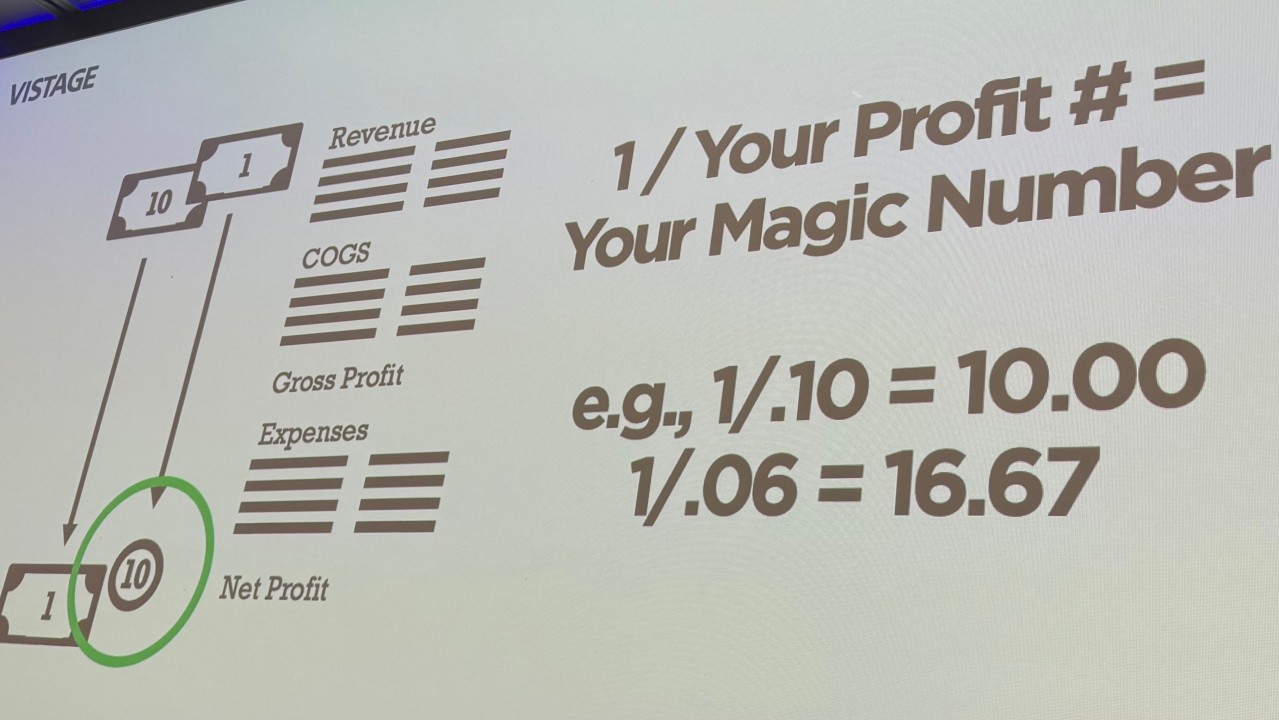
    In the average businesses, it takes $10 of revenue to make up for $1 of operational inefficiency.

    That’s not a finance abstraction. That’s daily behavior compounded over time.

    Most leaders understand this intuitively, but most employees never get taught this explicitly. And that gap shows up everywhere.

    The “Spoon Man” Story

    Steve shared a story from a multi‑unit café chain that made the point unmistakable.

    One employee – later nicknamed “the Spoon Man” – was responsible for smallwares, small dishes and utensils including spoons. Spoons were constantly disappearing and needing replacement. No malice. No carelessness. Just… no awareness as they got scraped off into the trash with leftover food.

    Annual replacement cost? Not much per spoon, but they added up to roughly $20,000 per year.

    At first glance, that sounds like noise – something you “sell more pancakes” to fix. But then Steve reframed it.

    To generate $20,000 in profit, the company needed more than $200,000 in additional sales. That’s a lot of pancakes!

    Same spoons. Completely different conversation.

    Once the Spoon Man understood the math, he and his kitchen teams changed their behavior – dramatically. Not because of a new policy. Not because of fear. Because they now understood how their decisions connected to the scoreboard of the business.

    I’ve Seen This Work from the Inside

    As Steve was telling that story, I kept thinking about a very real example from my own past.

    A good friend and colleague, Clayton Meeker, designed and taught an internal financial literacy program as part of Improving’s Employee Engagement Program (EEP). Rather than keeping financial understanding locked inside leadership meetings and the Accounting department, Clayton created a forum where employees learned good personal money management and how that translated to the business – revenue, margin, tradeoffs, and all.

    These weren’t compliance trainings. They were invitations to learn – to feed employee curiosity and create a culture of continuous personal improvement. Employees shared insights. Leaders shared context. Curious questions were encouraged – not shut down. The goal wasn’t control; it was clarity and a culture of employee engagement.

    And over time and across the whole EEP, something powerful happened.

    • People made better decisions.
    • Teams thought more holistically.
    • Ownership showed up without being demanded.

    That program didn’t just teach finance. It reinforced a culture of continuous learning and improvement that Improving was building and is still known for today.

    Financial Literacy is a Cultural Tool

    That’s what connected these two stories for me – Steve’s keynote and Clayton’s work at Improving.

    Financial literacy isn’t about spreadsheets. It’s about trusting people with the truth.

    The Great Game of Business philosophy rests on a powerful assumption:

    If people understand how the business wins, they will engage and help it win.

    Too many organizations:

    • Share revenue targets at the top
    • Discuss margin in closed rooms
    • Measure outputs without explaining impact

    So people optimize locally… and unintentionally destroy value globally. That’s not a motivation problem. It’s an education problem.

    Where This Becomes a Leadership Opportunity

    If culture really is “how we do things around here,” then financial literacy is culture. Not jargon. Not dashboards. But clear cause‑and‑effect thinking.

    When leaders withhold the economics of the business – often out of habit or fear – they create systems where:

    • Waste feels invisible
    • Tradeoffs feel abstract
    • Accountability feels arbitrary

    And leadership ends up carrying weight the organization could be sharing.

    A Better Question for Leaders

    Both Steve’s keynote and my experience at Improving left me sitting with the same question:

    Do the leaders and their teams that I work with know which “spoons” they’re holding?

    Not metaphorically. Financially.

    Because sometimes the fastest way to improve margins isn’t a new strategy or system – it’s a clearer explanation. And sometimes the most expensive thing in the room isn’t a bad decision. It’s an uneducated one.


    This article was first published in my LinkedIn newsletter, Feeding the Flame. Read the original.

  • Sharing Purpose

    Sharing Purpose

    Last night my wife and I had some friends over for dinner and one said, “I’ve decided that I hate working. I love the pay and the benefits, but I hate working — especially with people who won’t make decisions when THAT’S their role in the company.”

    Now there’s several things to unpack here, but I want to start with her not really liking her job and just working for money. Yes, we all need basic sustenance to survive, but most of us have choices beyond that about what we want to do for a living — and I encouraged her to think about what she really wants to do to leave her mark on the world and find a way to get paid to do THAT.

    There’s an old adage, “If you do what you really love, you’ll never work a day of your life.“ While that’s not really true because there will always be those days that you just have to struggle through, the reality is that you can usually find joy in it if you really know your purpose and repeat it like a mantra to remind yourself why you’re doing what you do.

    My purpose, my mission, is this:

    Uplift intentional leaders of innovative organizations making the world a better place for generations to come.

    You see, five years ago I started working as an executive coach, and three years ago I became a Vistage Chair, and in beginning my second career I started to feel that I needed to really understand my WHY. I needed to have a purpose, a mission, that drives me, inspires me, so I know why I do what I do, who I really want to help and magnify in this world, so that I don’t suffer those demotivated days or feel like I’m just selling my services to make a paycheck.

    In the Vistage Chair Academy, we had to write our individual WHY statements to understand our core motivations, but it was easy for me to let that statement drift into the background and ultimately be forgotten as I struggled to get my practice off the ground. Before long, I was just focused on “the work”. But after a year or so I found The Greater Purpose Approach, a program for Chairs by Suzanne Livingston whose purpose is to work with Chairs to do the hard, introspective, deep digging and rebuilding to help us discover our purpose and realize our potential greater impact on the world. And just recently at Chair World, our yearly Vistage conference for Chairs, Brendon Burchard was the highly energetic and motivational closing keynote speaker. I decided to read his books, High Performance Habits and The 6 Habits of Growth where he emphasizes that knowing your purpose and meditating on it throughout the day is key to staying focused. Staying mindful of your WHY is important so that you’re working on the right priorities and even showing up as the person you want to be as you plan your work, attend meetings, get things done, and even spend time with your family. If you do it right and stay focused on your WHY, it’s life changing.

    Now that I’ve discovered my purpose, and practice the habit of meditating on it at key times throughout the day, I get inspired — fired up, even! — about everything from selecting who I want to work with next, to preparing for meetings with them, to helping them understand their paths and work around their obstacles, to reflecting on their decisions and accomplishments and celebrating their wins!

    Let me break down the elements of my purpose statement so you can understand my WHY:

    • Work with intentional leaders — those who aren’t just reacting to changing market dynamics or stresses in the workplace but instead are intentionally choosing their goals and how to build their organizations to pursue them.
    • Of innovative organizations — companies, non-profits, and even government orgs who are actively thinking about how to do things differently, whether it’s through applying technology, inventing novel methods, or taking a drastically different approach to their work than others have to date so they’re not just doing things “the way they’ve always been done.”
    • Making the world a better place — they’re thinking of their impact on the world and not just “doing it to make money.” Yes, every organization has to manage money — it’s the life blood of an organization. But money and profits are just one system in an organism with many facets that are ultimately having a greater impact than just making the shareholders rich. This can take a thousand different forms, but you know it when you’ve got it.
    • For generations to come — thinking about the long-term effects on our children and their children, or on our employees’ and other constituents’ children. When we imagine the future we’re making, we can visualize the impact we’re having in enabling them to change the world for the better.

    Now every leader and every organization will have a different personal purpose or mission statement, so if you have one or have been thinking about what really drives you — what fires you up — I’d love to hear it! Please share it in the comments or message me. At the very least, we’ll celebrate it. But maybe we can work together to achieve it. Or if you’re struggling, maybe I can help you distill it and make it clearer so you and your org can really focus. In any case, we leaders usually don’t talk about our purpose and missions enough, so let’s make it front and center!


    This article was first published in my LinkedIn newsletter, Feeding the Flame. Read the original.

  • When Strength Becomes Weakness

    When Strength Becomes Weakness

    How to Recognize and Overcome Your Limitations

    As entrepreneurs, we often focus on leveraging our strengths to drive our businesses forward. While this is crucial, it’s equally important to recognize that every strength can also be a weakness. Understanding how your strengths might be limiting you can help you achieve a more balanced and effective approach to business growth.

    1. The Double-Edged Sword of Strengths

    Every strength has a flip side. For example, being detail-oriented can lead to perfectionism, which might slow down decision-making. Similarly, being highly creative can sometimes result in a lack of focus on practical execution. Recognizing these potential downsides is the first step in avoiding the negative.

    2. Over-Reliance on Strengths

    Relying too heavily on your strengths can create blind spots. For instance, if you’re excellent at sales but weak in financial management, you might not keep solid books or overlook critical financial issues.

    Balance your strengths with the necessary skills and knowledge in other areas to ensure well-rounded business management.

    3. The Importance of Self-Awareness

    Self-awareness is key to understanding how your strengths might be limiting you. Regularly reflect on your actions and decisions. Seek feedback from trusted colleagues or mentors who can provide an outside perspective. This can help you identify areas where your strengths might be turning into weaknesses.

    4. Balancing Strengths with Complementary Skills

    To overcome the limitations of your strengths, surround yourself with a team that complements your skills. If you’re a visionary leader but struggle with details, hire someone who excels in operational management. This balance can create a more effective and cohesive team.

    Add team members who have complementary strengths and delegate to them.

    Check out my last post on The Art of Delegating for some strategies on when and why to delegate.

    5. Embracing Flexibility and Adaptability

    Being flexible and adaptable is crucial in mitigating the limitations of your strengths. Be open to learning new skills and approaches. This can help you address areas where your strengths might be holding you back and allow you to grow both personally and professionally.

    6. Setting Boundaries and Prioritizing

    Sometimes, our strengths can lead us to take on too much. For example, if you’re highly driven and ambitious, you might find it hard to say no to new opportunities.

    Set clear boundaries and prioritize tasks to manage your workload more effectively and prevent burnout.

    I’m just reading The Effective Executive by Peter Drucker and have a lot of thoughts on prioritization and time management that I’ll post later.

    7. Continuous Improvement and Growth

    Recognize that strengths and weaknesses are not static. Continuously seek opportunities for improvement and growth. This might involve taking courses, attending workshops, or seeking mentorship. By actively working on your weaknesses, you can turn them into strengths over time.

    Licensed stock photo from Shutterstock

    Conclusion

    Understanding that every strength can also be a weakness is a powerful insight for entrepreneurs. By recognizing and working through the limitations of your strengths, you can achieve a more balanced and powerful approach to business growth. Embrace self-awareness, seek complementary skills, and remain flexible and adaptable. This holistic approach will help you navigate the complexities of entrepreneurship and drive your business to new heights.

    I’ll talk more about Managing your Priorities soon. If you want to talk to someone about it now, Book a Call with me. If you just want to read the next article in my newsletter, be sure to subscribe!


    This article was first published in my LinkedIn newsletter, Feeding the Flame. Read the original.

  • Mastering Delegation While Doing What You Love

    Mastering Delegation While Doing What You Love

    As an entrepreneur, you wear many hats. From managing finances to marketing your products or services, the list of responsibilities can seem endless. But trying to do everything yourself leads to burnout and can really drag down your business’ growth. The key to avoiding the overwhelming context switching that happens while running a small or mid-sized business is effective delegation.

    But where do you start?

    Delegating tasks effectively can significantly enhance productivity for you and your whole organization and allow you to focus on what you do best. Here are some strategies for choosing what to delegate:

    1. Repetitive Commodity Tasks: These are tasks that are routine and do not require your unique expertise. Examples include bookkeeping, data entry, and scheduling. Delegate these tasks to free up your time for more strategic activities.

    2. Tasks Outside Your Expertise: If a task requires specialized knowledge or skills that you don’t possess, it’s a good candidate for delegation. This could include IT support, legal work, or graphic design. The accountant in my peer advisory board told me,

    “I forbid you from doing your own bookkeeping. We see entrepreneurs doing it themselves and they always miscategorize transactions and create a huge mess for year-end reporting and taxes.”

    Delegate these tasks and ensure they are handled by someone with the right expertise.

    3. High-Effort, Low-Impact Tasks: Some tasks require a lot of effort but do not significantly impact your business’s growth. These tasks can be time-consuming and lead to procrastination. Examples include detailed research, extensive report writing, or complex administrative work. Delegate these tasks so you can focus on high-impact activities.

    4. Tasks You Dread: If there are tasks that you find particularly draining or unpleasant, consider delegating them. Procrastinating on these tasks can hinder your productivity. Delegate them so you’ll maintain your energy and can focus on tasks that you really enjoy.

    This is a great rule of thumb for building out your team:

    Hire people to do the things you hate so you can focus on what you love – and the bigger picture.

    But don’t cling to what you enjoy or are good at too long. That can be an antipattern, too.

    5. Tasks That Can Be Done Better by Others: Sometimes, there are tasks that, while you can do them, others can do them better or more efficiently. This could include social media management, customer service, or content creation. Delegating these tasks can improve the quality of work and free up your time for strategic decision-making.

    Specialists outside your organization often have better tools for the job than you do, allowing them to do the work in a fraction of the time it would take you.

    And if you delegate to someone inside your organization, make sure they have the tools they need. A few hundred dollars spent on tooling could save you thousands of dollars in their time.

    6. Tasks That Are Not Core to Your Business: Identify tasks that are not central to your organization’s core functions. These could include office maintenance, event planning, or routine procurement. Delegate these tasks so you can concentrate on activities that directly contribute to your business’ growth and success.

    7. Tasks That Offer Learning Opportunities for Your Team: Delegation can also be a tool for developing your team’s skills. Delegate tasks that provide growth opportunities for your team members. This not only helps in their professional development but also builds a more capable and versatile team. If it’s something that you’re really good at, try to find the higher reward of teaching others to be good at it, too.

    You Can Do It!

    By using these strategies, you can delegate effectively and ensure that your time and energy are focused on the areas where you can make the most significant impact. I have some new members in my CEO peer advisory board who are facing decisions about scaling and delegation. Should they hire from the outside or promote from within? What we talked about in the group is the fact that preparing for and successfully executing either (or both) is pretty much the same. Remember, successful delegation involves clear communication, trust, and regular follow-up to ensure tasks are completed to your satisfaction.

    I’ll talk more about “Trust but Verify” at another time. If you want to talk to someone about it now, Book a Call with me. If you just want to read the next article in my newsletter, be sure you’re subscribed here.


    This article was first published in my LinkedIn newsletter, Feeding the Flame. Read the original.